

Does Selling Foreign Reserves Increase Money Supply
Topic 5. Monetary Policy, Interest Rates and the Substitution Rate
It should now exist articulate that the government of a small open economy of the sort we accept been analyzing tin control that state'southward nominal exchange rate and, a least for short periods, its real exchange rate every bit well. Indeed the nominal and existent exchange rates are the mechanism through which monetary policy works. Many people, including virtually primal bankers, claim that governments of pocket-sized open economies can also control domestic interest rates and frequently use this control in implementing monetary policy. We now investigate these issues in more particular.
The central bank, acting on the government'due south behalf, can move the real exchange rate by means of budgetary policy under a flexible exchange rate regime when there is less-than-full employment. Fiscal and commercial policy can also permanently alter the existent substitution rate under full-employment conditions while budgetary policy can bear upon only the nominal exchange rate in this instance. Financial and commercial policy will touch on the nominal exchange charge per unit whenever it is flexible.
Information technology is also widely believed that the government can manipulate the nominal exchange rate by only ownership and selling foreign currency for domestic currency on the international marketplace. This argument is analyzed below. But start we need to investigate the ability of the small open economy'due south authorities to manipulate domestic interest rates.
From the computer-assisted learning module The Foreign Exchange Market y'all should have learned that the domestic and strange nominal and real interest rates are related as follows:
1. id = if + Eπ + ρ
2. rd = id - Epd
iii. rf = if - Eastwardpf
4. rd = rf - Eastwardq + ρ
where i and r are the nominal and real interest rates respectively, the subscripts d and f denote domestic and strange, and Eπ , Eq and Ep are, respectively, the expected rates of alter of the nominal and real exchange rates and price level.
The first equation says that the domestic nominal involvement rate must exceed the foreign nominal interest rate by an allowance for risk ρ plus an amount equal to the capital loss expected on domestic nominal assets relative to foreign assets from the time to come ascent in in the cost of foreign currency in terms of domestic currency---otherwise people would shift asset holdings between domestic-currency and strange-currency denominated bonds. The 2d and tertiary equations are the Fisher weather---each country's nominal interest charge per unit must equal its real interest rate plus the expected rate of inflation. The fourth equation says that the domestic real involvement rate must exceed the foreign real interest rate by the risk premium minus the expected charge per unit of increment in the real exchange charge per unit---an increment in the expected real exchange rate creates an expected capital proceeds from holding domestic rather than foreign real uppercase appurtenances, making it assisting to agree them at a lower real interest rate.
Equation 4 implies that the domestic authorities tin can raise the domestic existent interest rate by making domestically held capital more risky---that is, increasing ρ ---or by inducing an expected time to come turn down in the domestic real exchange charge per unit. The latter could be brought about past reducing the money supply under circumstances where domestic residents know that the resulting appreciation of the existent exchange rate is a temporary overshooting aligning that will subsequently dissipate. If the exchange charge per unit is perceived to exist a random walk, however, the expected future real substitution rate will always equal the current charge per unit and Eq will exist zip. These conditions give the small country'southward central bank little room to manipulate the domestic real involvement rate.
It is quite easy for the domestic key bank to manipulate the nominal interest rate. By changing the rate of expansion of the domestic money supply it tin ultimately alter the domestic rate of inflation. As soon as the new rate of inflation becomes anticipated the domestic nominal interest rate will adjust accordingly. Although changes in the existent involvement rate, if perceived to be permanent, are likely to affect domestic investment, nominal involvement rate changes past themselves have no effects on investment, output and employment.
The above conclusions seem to conflict with the assertions of most central banks that they conduct their monetary policy by manipulating domestic involvement rates. On closer test of these claims, even so, it is apparent that the interest rates primal banks claim to command are the interest rates on overnight loans of reserves between commercial banks and not the real interest rates that enter into the decision of investment expenditure. Every bit banks clear cheques drawn on each other, reserves are constantly shifting from banking concern to banking concern. Since these reserve holdings bear minimal interest, banks will choose to keep them as small as is consistent with their obligations to their depositors and any government regulations that apply. When a bank's reserves are drawn down unexpectedly it volition borrow reserves on an overnight basis from other banks who accept a surplus over their needs. When all banks find themselves short of reserves the interest rate on these overnight borrowings volition increase and when they accept surplus reserves the overnight rate will decline.
These interest rates on overnight borrowing will never diverge persistently from the involvement rates on the broad range of other avails in the economy because, given a few days or a week, banks tin always liquidate their assets to furnish reserves or shift excess reserves into a broad range of assets. And the domestic interest rates at which banks can lend and borrow in the economy equally a whole are anchored to foreign interest rates on securities of equivalent take chances and maturity.
In many cases a central bank, by increasing and decreasing the reserves of the banking system, tin substantially move the overnight rate on inter-depository financial institution loans, simply the effect is necessary temporary since the banks can access the broader capital market within a day or ii. Every fourth dimension the central bank expands reserves, of class, information technology increases the coin supply and every time information technology contracts reserves the domestic money supply declines. Central banks usually too set an involvement charge per unit at which they will lend as a "last resort" to commercial banks that are brusque of reserves. This involvement rate, called depository financial institution charge per unit, is usually announced in advance along with a target level or range at which the primal bank would like to keep the overnight interbank borrowing rate.
While the key bank may practise the intention of moving the overnight borrowing charge per unit up or down it can never be sure that it has accomplished its goal, since this rate is likewise afflicted by market place atmospheric condition which cardinal banking concern economists tin just forecast imperfectly. The banking company thus volition often not exist able to make up one's mind whether it was responsible for moving the overnight charge per unit in a particular direction or whether the charge per unit would have moved in that direction anyway.
One way a fundamental banking concern can maintain pinpoint control over the rate of interest on overnight borrowing of reserves is to brand deposits with it the entire source of such reserves and to pay interest on those deposits at rates that will maintain its position as the sole source of overnight reserves. Equally long equally it is gear up high plenty, this involvement rate comes under the straight control of the fundamental bank, and will be correlated with market rates simply to the extent that the authorities manipulate it to exist then correlated.
Nevertheless, the home truth is that everytime most fundamental banks try to manipulate their overnight charge per unit they modify the coin supply in a direction that tin can be predicted from its declared intentions. And, to the extent that they control the overnight rate directly, they can change the stock of reserves without affecting it. By changing the official level or range for the overnight rate, a central bank tin can inform the private sector of its policy intentions, whether or non its subsequent actions really significantly affect the rate. Such announcement affects volition affect market place expectations. Changes in bank rate perform the same function, whether or not the central bank really loans a meaning quantity of reserves to the cyberbanking system at that rate.
Figure 1 plots the Canadian year-over-year inflation rate together with the interest rates on Canadian treasury bills and ninety-day commercial paper and the involvement charge per unit on overnight borrowing of reserves by the cyberbanking system. The latter charge per unit is essentially set by the Banking concern of Canada. A similar plot for the United Kindom, presented in Figure 2, presents the inflation rate along with the interest rate on U.K. treasury bills and the official banking company rate. Figure 3 plots the U.South. year-over-yr inflation rate along with the interest rates on U.S. treasury bills and 90-day commercial paper and the federal funds rate, which is the interest rate targeted by the Federal Reserve Banking company in conducting U.S. monetary policy.
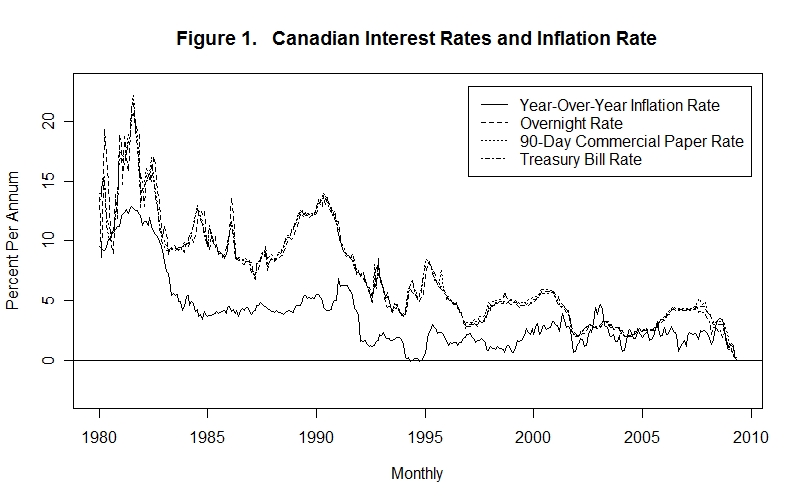
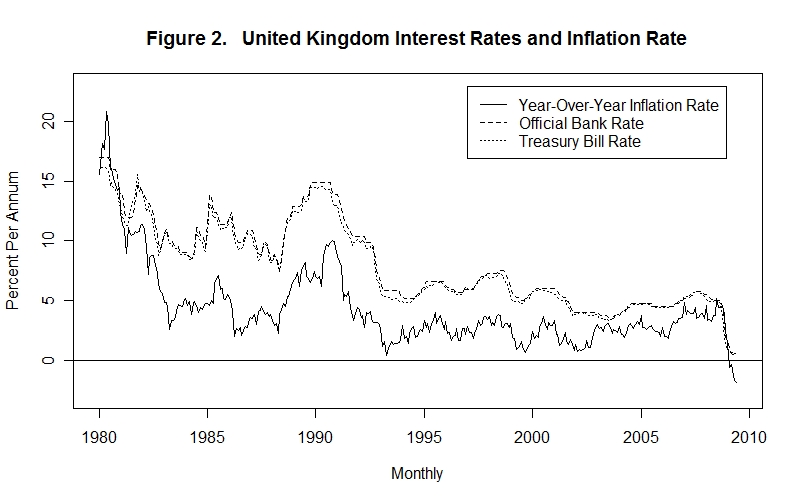
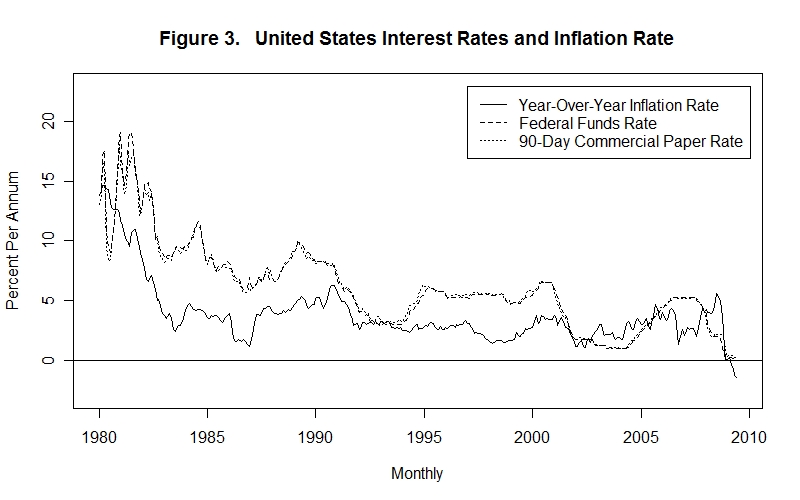
Equally is quite evident from the above plots, there is a strong positive human relationship between each country'southward yr-over-year aggrandizement rate and its interest rates. Indeed the coefficients of correlation of the treasury pecker rates and the year-over-year inflation rates are .826, .816, and .741 for Canada, the United kingdom and the United States respectively. Of grade, nosotros would expect the correlations betwixt the interest rates and the expected inflation rates, which are unobservable, to be much college than those between the involvement rates and the actual inflation rates. The differences between the interest rates plotted for each country are quite small.
Figures iv, 5 and vi below plot, for the past viii years, the involvement rates that the authorities of the respective countries claim to control along with the xc-solar day commercial paper charge per unit in the case of the United States, the 90-day commercial paper and treasury neb rates for Canada and the treasury bill rate in the case of the United Kingdom.
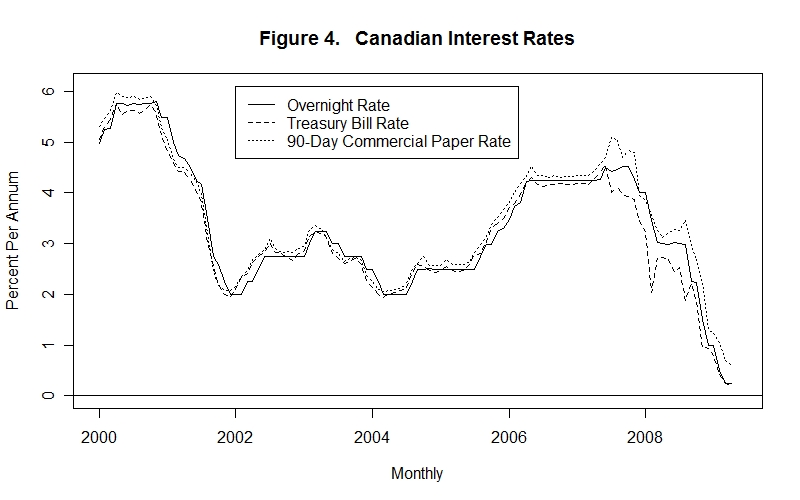
Note that the Canadian commercial paper rate tends to be above that country's treasury neb rate as is consistent with the fact that corporate paper tends to be more risky than treasury bills. The interest charge per unit on overnight borrowings of reserves, which the Banking company of Canada controls, tends to be beneath the treasury nib rate when the latter is ascension and above the treasury bill rate when that rate is falling. This would be consequent with a procedure whereby the Banking concern of Canada adjusts the overnight rate to proceed it in line with market weather rather than utilise of the borrowing rate to induce changes in other market place rates. Indeed, given the beingness of an international market for Canadian treasury bills, it is hard to imagine how world asset holders would change their evaluation of those securities based on the interest rate on overnight borrowing of bank reserves. The simply possibility would exist that the Depository financial institution of Canada's adjustment of the borrowing rate would alter earth asset holders expectations about hereafter Canadian inflation. There is no basis for arguing that the underlying existent interest rates relevant for domestic capital investment will be affected by Depository financial institution of Canada manipulation of the overnight borrowing rate, even if that happens to involve changes in the Canadian money supply. Coin supply changes would be expected to lead instead to overshooting movements in the Canadian nominal and real exchange rates, implying that the Canadian government should use the effects on the nominal exchange rate every bit a measure out of the degree of expansiveness of their budgetary policy---it is the effect on the real commutation rate that leads to changes in amass need.
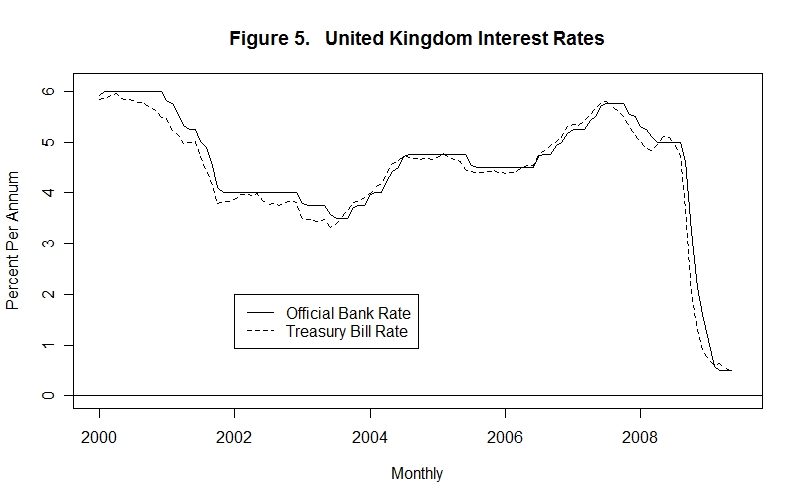
In the United Kingdom the official bank rate, which the Depository financial institution of England controls, also tends to exist below the treasury bill charge per unit when the latter is rising and above it when it is falling, as is consistent with the possibility that the authorities adjust bank rate in response to changes in market place interest rates. Although the United kingdom is much larger than Canada, it is still a sufficiently pocket-size fraction of the industrial globe economy to make the real interest rate on domestic treasury bills virtually entirely dependent on world market place demand---globe asset holders' evaluation of the probability that Britain will default on these bills would seem unlikely to change. Of course, investors evaluation of the prospects of future British aggrandizement may alter in response to a change in the official bank rate, inducing some alter in the market interest rate on the country's treasury bills. But such evaluations of future inflation will pb to a rise in the treasury beak rate in response to a reduction in the banking concern charge per unit, not a fall that would exist predicted to result from monetary expansion. Once more, domestic monetary expansion will operate through alter in the exchange rate, not reductions in the domestic real interest rates relevant for investment decisions.
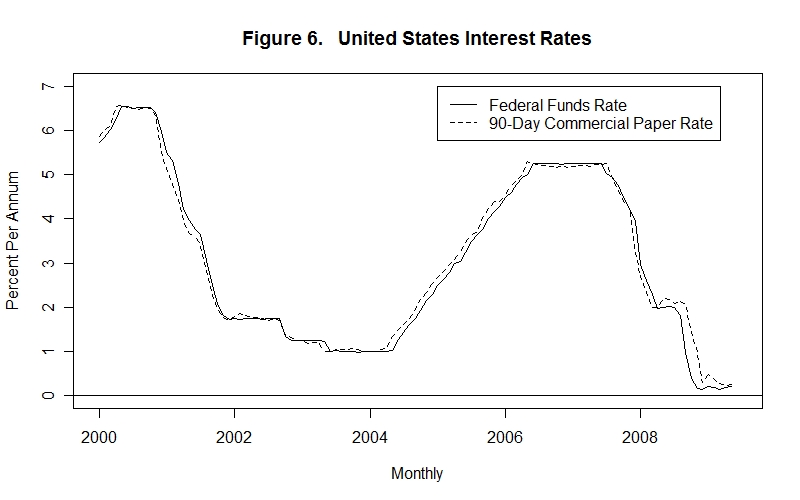
Finally, information technology is obvious from Figure 6 that the U.S. federal funds rate, which the Federal Reserve Organisation purports to control, too tends to be above the interest rate on commercial paper when the latter is falling and beneath information technology when information technology is rising---the same outcome as was evident for Canada and the United Kingdom. Unlike the other ii countries, yet, the United States has to be regarded as a major fraction of the industrial globe economic system. I would therefore await that a monetary expansion in the United States would lead to some reduction in U.S. and world existent interest rates. Moreover, the federal funds rate is determined in the private marketplace and the influence of the Federal Reserve System on it is therefore not like shooting fish in a barrel to measure.
Even though the U.S. is a large open economic system, making its domestic budgetary expansion likely to represent a meaning increase in the world coin supply, an overshooting response of the U.S. exchange rates with respect to other industrial countries is likely to result from domestic monetary expansion. Information technology might be reasonable for the U.S. Federal Reserve System to only ignore such exchange rate furnishings of its policies, as the external value of the U.S. dollar need not be of much concern. Such overshooting exchange rate movements should nevertheless be of concern by foreign monetary authorities as a U.S. expansion will take the same overshooting effect on their exchange rate with respect to the U.South. as would a domestic budgetary contraction. If these authorities adjust their domestic money supplies to neutralize such overshooting, the world coin supply will farther expand as a issue of the U.S. monetary expansion. In the extreme case, the earth money supply will expand in the same proportion as the U.S. coin supply---all countries will be following identical budgetary policies, with the U.Due south. Federal Reserve Arrangement in charge!
Finally, allow u.s. investigate the claim that the regime can control the commutation rate by simply buying and selling domestic currency for foreign currency on the international market. On the surface this seems reasonable because one should be able to affect the toll of a currency past changing the supply of it going onto the market. But this volition depend on the issue of the foreign commutation market intervention on the coin supply.
Y'all should recollect that money supply is some multiple mm of the stock of base money H which is, in turn, the sum of its two source components, the domestic source component Dsc and the stock of reserves or foreign source component R
5. M = mm H = mm [R + Dsc]
An increase in the stock of reserves will raise the coin supply but if the authorities do non sterilize its effects past equivalently reducing the domestic source component. If the authorities sterilize the effect of their purchases or sales of foreign substitution reserves by open up market operations in domestic bonds, and so that [R + Dsc] remains constant, their deportment tin can accept no significant result on output or prices. This can be seen from Figure 7. Equilibrium is adamant by the intersection of the LM bend and the ZZ line. If the money supply does not modify, neither does the LM curve and neither does the equilibrium. The nominal exchange rate that will bulldoze IS through the LM-ZZ intersection remains unchanged.
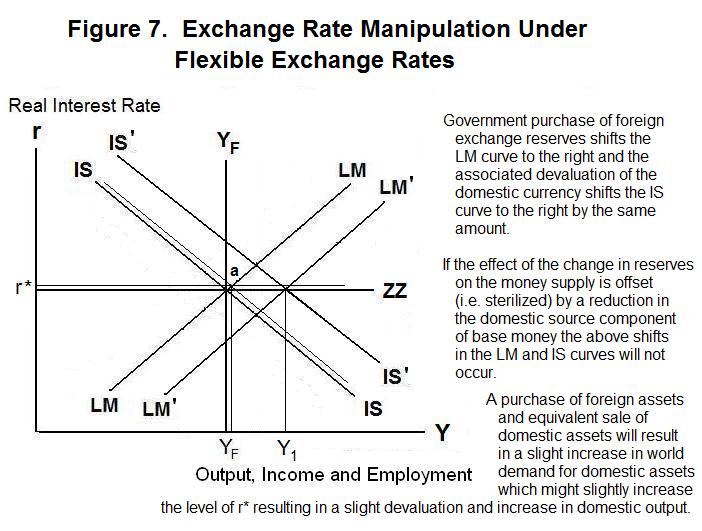
When the government purchases foreign exchange reserves with domestic currency on the international market it increases the money supply. When it sells bonds of equivalent value it reduces the money supply by the same amount. A possible effect on the substitution charge per unit would be a timing effect since the purchase of foreign currency occurs immediately, while the auction of foreign currency in return for domestic currency by domestic residents as they rebalance their portfolios later purchasing bonds from the government may take some time. At that place might thus be some temporary depreciation of the exchange rate.
As well, a sterilized official purchase of strange exchange reserves might accept a tiny effect on the domestic interest rate. The regime is ownership foreign assets when information technology increases its strange exchange reserve holdings and selling domestic assets when information technology sterilizes the effect of the foreign exchange reserve increase on the domestic coin supply. Since this creates an excess supply of domestic non-monetary assets on the international market, the domestic interest charge per unit volition rise relative to the strange interest charge per unit by a tiny amount if domestic and strange avails are not perfect substitutes. ZZ will shift upwards in Figure 7---a slightly higher domestic involvement rate will now be associated with the existing globe interest charge per unit. A slight devaluation of the domestic currency will then occur to shift IS through signala .
For a significant interest rate effect to remain in the long-run, however, the adventure premium on the domestic avails must permanently and significantly increase as a event of this portfolio shuffle. Since, for changes in strange substitution holdings of the magnitude usually experienced, the commutation of domestic for foreign avails will be an extremely small fraction of the world asset portfolio, the upshot on domestic relative to strange involvement rates, the substitution rate and domestic output will surely be minuscule.
Of class, if the event of an increase in official foreign substitution holdings on the coin supply is non sterilized by an open up-market operation in domestic bonds, the domestic money supply will increase and the LM bend will shift to the right. Employment and/or prices will increase, when the substitution rate is flexible, in the aforementioned manner as would take occurred from any increase in the coin supply, no matter how it was generated.
Time for a test. Make sure you call back up your ain answers before looking at the ones provided.
Question one
Question ii
Question 3
Choose Another Topic in the Lesson.
Source: https://www.economics.utoronto.ca/jfloyd/modules/mixr.html
Posted by: roewhattlial.blogspot.com
0 Response to "Does Selling Foreign Reserves Increase Money Supply"
Post a Comment